

The Spinout Effect: How Activist Lineages Are Driving Growth and Outcomes
In startups, exceptional companies often produce a second generation of influential founders—the “PayPal mafia” being the canonical example. Activism is proving no different. When a firm develops a distinctive playbook, compounds credibility, and delivers repeated success, it does more than win campaigns. It becomes a training ground. Alumni leave with experience, networks, and reputational capital that can be redeployed into new firms, new pools of capital, and new forms of influence. In that sense, leading activist funds do not merely participate in the market; they help build it.
This report examines that dynamic through the firms launched by alumni of eight major activist platforms: Elliott, Starboard, Icahn, Trian, ValueAct, Pershing Square, JANA, and Third Point. The evidence suggests that these spinouts have become an increasingly important source of campaign activity. Their significance lies not only in number, but in function. By adding new vehicles, specialized teams, and fresh capital, spinouts expand the market’s overall activism capacity without requiring legacy firms themselves to increase public campaign volume at the same pace.
That expansion is now visible in practice. Firms such as Irenic Capital, Donerail Group, Fivespan Partners, and Ananym Capital show how experienced teams can establish credible independent platforms and secure influence through cooperation agreements, board representation, and transaction-driven campaigns, often without a prolonged proxy contest. The point is not simply that former activists are founding new firms. It is that these firms are already shaping outcomes in ways that make the market broader, more specialized, and more resilient.
For boards and advisers, the implication is immediate. Activism surveillance can no longer be organized solely around a fixed roster of incumbent names. It must also account for networks, institutional lineages, and the firms emerging from them. The most important actors in the next cycle may not always be the legacy platforms themselves, but the alumni they trained.
Our focus is on the broader ecosystem surrounding these eight prominent activist firms and the investment platforms founded over time by former professionals from those organizations. These range from earlier examples such as Corvex, MHR, and Mantle Ridge to more recent entrants such as Donerail, Vision One, and Fivespan. The analysis examines how this wider ecosystem is influencing the activist landscape, both in campaign activity and in outcomes. The underlying premise is straightforward: alumni of the most successful activist platforms often carry forward proven playbooks, seasoned judgment, and market credibility, enabling their firms to play an increasingly meaningful role in activism’s next phase.
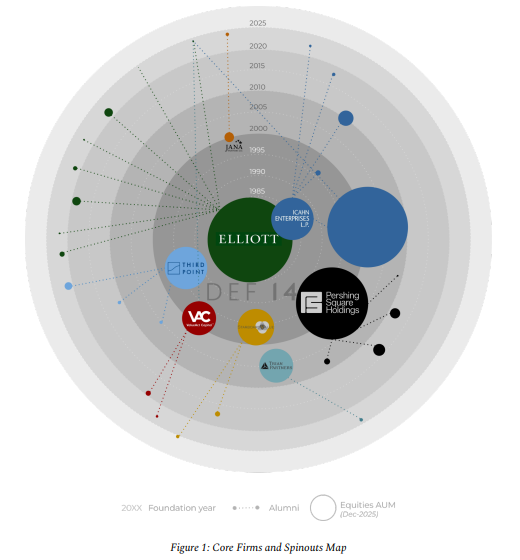
Figure 1 maps the relationship between these “Core Firms” and their “Spinouts.” Bubble size represents relative public equity assets, while positioning reflects each firm’s founding year.
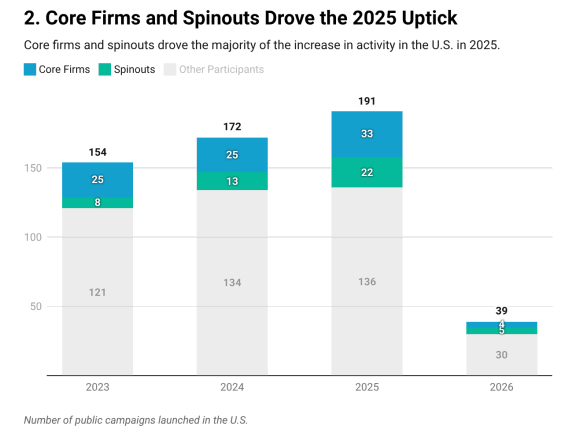
The first major takeaway is that the rise in campaign activity in 2025, based on DEF 14 data, was driven largely by this cohort of firms (see Figure 2). That said, this is not a homogeneous group.
Among the Core Firms, what separates Elliott and Starboard from several of their peers is not simply scale, but posture. While others have become more selective, diversified into adjacent strategies, or reduced the pace of public campaigns, these firms remain unusually committed to public activism as a primary mode of deployment.
Trian and Pershing Square illustrate the contrast. Each has increasingly directed its attention toward other strategic objectives, whether through concentrated ownership structures, transaction-oriented opportunities, or models closer to long-term platform building than traditional campaign activism. Icahn has remained active, but at a relatively stable and lower-volume pace, with annual campaign activity typically staying in the low single digits.
By contrast, Elliott, Starboard, and, to an extent, JANA continue to operate with striking intensity. Elliott is the clearest outlier, pairing elevated campaign activity with an increasingly international reach, particularly across Europe and Asia. Starboard and JANA have remained more US-centric, but both continue to be defined by a sustained willingness to engage.
Third Point, meanwhile, has tilted more decisively toward event-driven activism. Its recent collaboration with D.E. Shaw reflects a strategy increasingly centered on hard catalysts and specific situations, rather than on broad proxy contests as a default tool. Even so, the firm retains the capacity to run a fight when needed; what has changed is less its capability than the circumstances under which it chooses to deploy it.
The spinout cohort is even less uniform. Public data shows only the portion of activity that becomes visible through campaigns or settlements, but many newer firms are designed around private engagement first. In some cases, managers intentionally cap assets and limit the number of campaigns they run in order to remain concentrated and improve the odds of success.
That makes spinouts a diverse set rather than a single strategic category. Beneath the headline grouping sits significant variation in style, scale, visibility, and pace. Some firms are becoming active public campaigners; others are deliberately quieter, pursuing a smaller number of situations with a more selective and less visible approach.
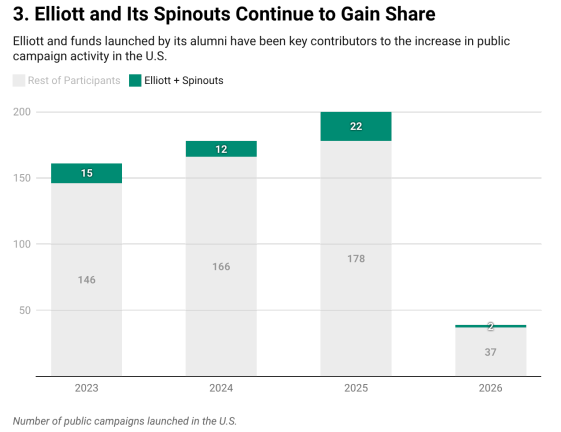
The Elliott ecosystem stands out as a central force behind that increase (see Figure 3). Activity rose at both the core firm and across its spinouts, making the broader Elliott lineage one of the most important contributors to the year’s campaign volume. The same dynamic was evident at Starboard, where the flagship platform and its spinout network—particularly Donerail—also recorded higher levels of activity.
Another important feature of this ecosystem is that these firms do not operate in isolation; they increasingly interact through shared networks, overlapping talent, and, at times, cross-lineage participation in campaigns and settlements. A good recent example is Integer, where Irenic’s March 2026 cooperation agreement resulted not only in the appointment of James Flanagan, but also of Aaron Kapito as the investor-designated director. That is notable because Kapito is a partner and co-founder of Politan Capital, a peer activist spinout, and he previously worked at Elliott before launching Politan. In other words, an Elliott-derived firm, Irenic, secured board representation through a principal from another Elliott-derived platform, illustrating how activist pedigrees now function less as isolated franchises than as an interconnected network of operators, relationships, and trusted executives. For boards and advisers, that matters: influence in today’s market often travels through these informal lineages as much as through the formal name on the 13D or cooperation agreement.
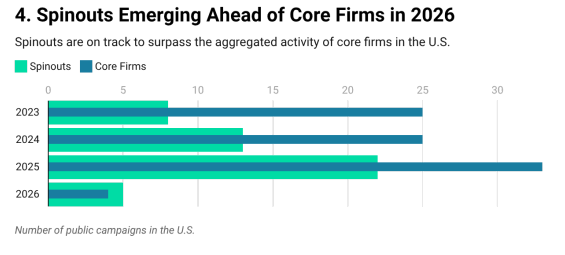
One of the defining themes of 2026 so far is the speed with which spinout firms are gaining visibility and campaign traction (see Figure 4). Irenic has already appeared in at least two public situations this year, at Ralliant and Integer. Fivespan entered the field quickly with its Appian campaign. Donerail has also been active out of the gate, escalating at MarineMax and securing a cooperation agreement with Turtle Beach.
These firms remain smaller than their parent platforms, but they are beginning to close the gap where it matters most: in visibility, tempo, and demonstrated capacity to shape outcomes. What was once a secondary layer of the market is becoming a more consequential part of its front line.
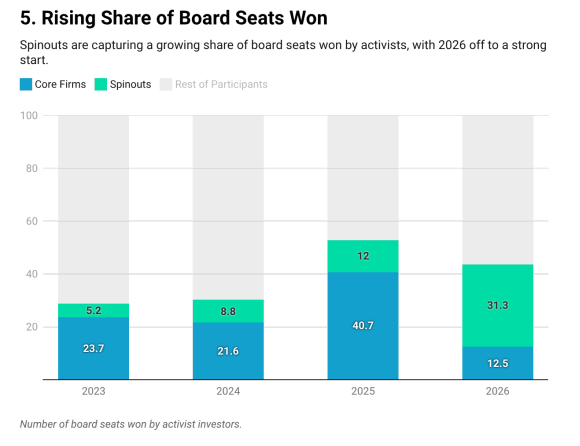
Increased activity is only one dimension of the shift. Equally important is the growing share of successful board-representation outcomes being captured by these firms (see Figure 5). DEF 14 data shows that spinouts in this group won 13 of the 108 total board seats secured. When their core firms are included, the combined total accounts for roughly half of all seats gained—suggesting that pedigree, institutional experience, and strategic inheritance remain powerful advantages in activist investing.
This matters because board seats are among the clearest indicators of real influence and campaign success. On that measure, spinouts are no longer peripheral actors. They are claiming a rising share of the market’s most tangible outcomes.
The pattern appears to be strengthening in 2026. Early results suggest that spinouts are on track to capture an even greater share of successful board-representation outcomes this year, further underscoring how the next generation of activist firms is beginning to translate lineage into measurable impact.
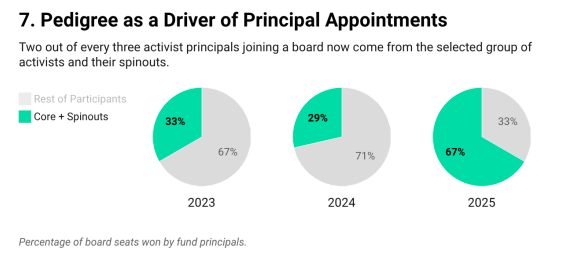
The pattern is even more pronounced when the outcome is not just a board seat, but a seat for a principal of the activist fund itself (see Figure 6). Here, the share linked to core firms and their alumni has risen from roughly one-third to nearly two-thirds of all such appointments.
That is a powerful signal. It suggests that in negotiated settlements, boards place real value on track record, proven playbooks, and institutional pedigree—particularly when the proposed director is not an outside candidate, but the activist itself at the table.
Outside this cohort, a broader set of newer activist firms is also beginning to shape the market, including spinouts from other activist and multi-strategy platforms. HoldCo, for example, has emerged as a notable force in banking activism, while firms such as Impactive Capital illustrate how influential lineages extend well beyond the eight core names examined here. Impactive was founded by Lauren Taylor Wolfe and Christian Alejandro Asmar, both of whom previously held senior investing roles at Blue Harbour Group.
Even so, this analysis deliberately focuses on a narrower group: firms whose names and histories are widely recognized both within activism and outside it. That constraint is analytical rather than dismissive. It allows us to isolate a set of platforms that have become canonical reference points in the market, while recognizing that the broader universe of spinouts and adjacent activist formations is larger, more diverse, and increasingly important. We will continue to examine how these firms, both inside and outside this core group, are reshaping the activism landscape through new strategies, new networks, and new forms of influence.
Data: DEF 14 Inc. (def14.co) | Chart: Created with Datawrapper | ©2026 DEF 14 Inc. All Rights Reserved.
Legal Disclaimer:
EIN Presswire provides this news content "as is" without warranty of any kind. We do not accept any responsibility or liability for the accuracy, content, images, videos, licenses, completeness, legality, or reliability of the information contained in this article. If you have any complaints or copyright issues related to this article, kindly contact the author above.
